Showing posts with label Ring. Show all posts

Wednesday, July 7, 2010

Verna makes the news in China!


The intrepid, indefatiguable Verna Parino, former president and founding member of WSNC
, recipient of Opera Volunteers International "Partners in Excellence" award for 29 years as preview chairman of the San Francisco Opera Guild, inveterate opera traveler and Ring-attendee extraordinaire made the news in a major Chinese newspaper a few days ago after they caught wind of the fact that a 93-year old woman was traveling all the way from San Francisco to Shanghai in order to attend her 58th Ring. The letter from the friend who sent it explains the headline:

Dear Verna
Please see attached newpaper of Jun. 26 Saturday of Xinmin Evening News, which is the among the oldest and biggest evening newspapers in China. Hope you enjoy it.

The title is "93 years lady longing for 58th cycles of The Ring in Shanghai". The article is based on your interview in Email and adapted by a famous Shanghai reporter Mr. Yang Jianguo.
Have a nice day.
Pan


Addendum:

Verna forwards a rough translation of the article:

The music drama “Wagner’s rings” , co-sponsors by Xinmin News and City Dancing Co., will be on staged in September in the Shanghai Grand Theatre for eight performance. Once announced, audiences bought and booked tickets enthusiastically. An 92 years old lady, Ms. Verna Parino, who had booked 4 performances of the music-drama and proposed her wish to visit the World Expo aroused the curiosity of the reporter in Xinmin News. The reporter interviewed her through internet and got her 3 pages reply immediately.

Ms. Verna Parino said she has watched 57 cycles of the Ring in 30 cities in 18 countries and she is going to watch her 58 cycles of the music-drama in Shanghai. Ms. Parino lives in San Francisco and was a medical worker. In 1930’s she listened the Ring radio broadcasts from the Metropolitan Opera and the first time to attend the performance was in 1973 in San Francisco . From that performance on, she has been fond of music drama , especially the Rings. Since then, she has became member of the San Francisco Opera and the San Francisco Symphony . Also , she joined the Wagner Society of Northern California and became its president for three years . After her husband passed away, she has acted as an art volunteer. Because she is so fond of the “Rings” , besides writing comments of the Rings, she enjoys collecting worldly researches or information relating to that music drama . In Ms. Verna Parino reply letter, she also shared with us her happiness and challenges in attending the cycles and collecting information of the music drama.

She said everytime she watched the performance, she will be inspired and got something new for her to comprehend. She mentioned this music drama tells about the beginnings of the world, inner conflicts of human beings and the struggling and fighting for worldly power. The story simulates the audiences to explore the meaning of existence of human beings. The reason for her pursuing to attend the performance is the gorgeous orchestral music pouring out the beautiful feeling of human beings and providing her to enjoy in an excited state . For her, she has addicted to watch the “Rings” and her life and the Rings have already fused together. When she was told that the Rings will be performed in Shanghai at a meeting of the Wagner Society , she immediately decided to watch her 58 cycles and visited Shanghai again. She visited Shanghai in 1982 with a tour group and attended a concert. She recalled during the intermission, some audiences gathered round and looked at the musical instruments and some attendees searching dictionary to communicate and chat with her in English . After that , I got a copy of the recording broadcast from Kurt Herbert Adler, the General Directo of San Francisco Opera . When she listened the records, she also can hear her applause and “Bravo”.

Shanghai is a sister city of San Francisco. These years, she really wants to visit Shanghai again and watching the Rings provides her a good reason to visit Shanghai again. Members of the Wagner Society told her it’s worth for her to visit the World Expo if she be there. Recently, she has watched news about the Expo in the internet and found it’s very attractive and wonderful. Ms. Parino said that her health is not bad and long distance flight will not be a problem for her but may be a problem for her to walk too much . So, she will bring a wheelchair and will arrive Shanghai two days early .

Finally, she hopes her visit in Shanghai will be a wonderful and happy journey and she is happily looking forward for that.

(Verna points out that she was not a medical worker, although she did work for a period in the business office of the Mayo Clinic.)

Thursday, March 11, 2010

Review: Opera in Cinema's 2008 Valencia Siegfried


From the Opera in Cinema website:

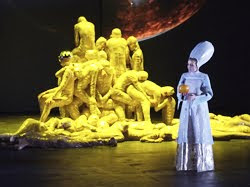
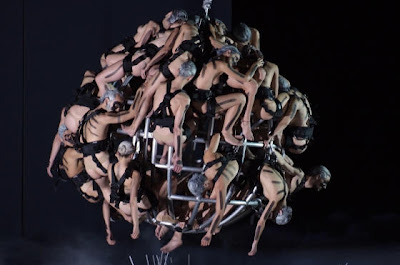
"In the words of the prestigious German weekly "Die Zeit," the stage production of Wagner's "Rheingold" and "Walküre" by La Fura dels Baus "quite possibly shows us the path that musical theater will be taking in the future." There's no doubt about it: the city of Valencia is setting new accents in 21st-century opera not only with its spectacular new theater designed by Santiago Calatrava, but also with its visually transfixing production of Wagner's "Ring" staged by Carlos Padrissa and his theater group La Fura dels Baus. The Barcelona-based Fura blends music, dance, acrobatics and technology into unforgettable stage events of sometimes raw but always captivating power."


Photos: © Tato Baeza

Siegfried Visits Beaubourg
or Verfremdungseffekt vs. Gesamtkunstwerk

Larry and I were able to see the 2008 Valencia Siegfried during a recent screening of Opera in Cinema's season last weekend (2/14) in Cleveland. I left the theater less than overwhelmed, but further reflection has led to some insights -- and greater appreciation -- for what the director (Carlus Padrissa) may have attempted. Not having seen this cycle's Rheingold or Walküre is a distinct disadvantage in trying to figure out a meaningful arc to the Valencia Ring, but any one opera in the tetralogy should be able to stand alone well enough to stand at all. So, let's blame the initial confusion on the cinematography (for now).


The cast was universally strong -- particularly Lance Ryan (Siegfried), Juha Uusitalo (Wanderer), and Stephen Milling (Fafner). Franz-Josef Kappellmann (Alberich) and Jennifer Wilson (Brünnhilde) were also effective. Gerhard Siegel's Mime, however, may provide the key to the production -- less the buffoon than is often the case and genuinely overwhelmed and frustrated by his task. But, it was Siegfried's night, and Lance Ryan was superb, looking as though he could manage another hour or so by the time he had seduced Brünnhilde.


On face value, the production, however, just did not come across as anything but a mess -- at least the way it was filmed. Much of the "action" took place on huge, multiple, and very busy projections against a rear screen which was very close to the actors. This placement compressed the very broad "stage" into a very shallow space on which to act. A highly polished black floor surface reflected the backdrop screening, increasing the motion enveloping the singers. Dancers doubled as stage hands who moved the sets around, became props (a bench for Siegfried, forest debris), and in act one even mopped the floor.


In pure Brechtian terms, the mechanics of production were all visible and became part of the performance -- from Fafner's hydraulics linking a skin of movable triangular plates; Erda's "cherry picker" seat thrust out from a crack in the filmed earth; a recreation of the Giant machines, one controlled by the Wanderer; Wotan's spear with its clearly visible break-away mechanism; projection screens opening to reveal reverse-side framework; a mobile forest of hinged, highly-polished chrome boxes. These mobiles ended in small round platforms on which Wotan and Alberich confronted each other, rising and falling, swaying side to side as light and dark vied for command of the argument. The skeleton structure is no longer invisible but takes center stage.


The design concept is similar to those employed by Renzo Piano et. al. for the Pompidou Center (Paris, 1977) where all the structural elements are not only fully exposed but also color-coded to indicate the various mechanical systems normally hidden behind interior walls. Padrissa's conception strips away all artifice, exposing the power struggles residing at the heart of the Ring story. It is also primarily a struggle for the right to tell a story that is larger than any single, unified vision of truth.


The filming, however -- with its heavy emphasis on close-up shots -- undercut much (dare I say "most"?) of the overall effect one would have had in the theater where the audience could experience the entire project as a whole. The close ups significantly reduced the perception of the singer/actors overwhelmed by the activities swirling around them, a key component of the production. On stage, the singers would have appeared as only one aspect of the theatrical presentation rather than the center where tradition -- and the filming -- placed them. On the other hand, one might safely claim that the act of cinematic montage further fragmented what Brecht might have called the constructed reality of the work itself and, consequently, enhanced the defamiliarization effect on the audience. In terms Penn and Teller would appreciate (and thanks to Larry's analogy), Padrissa and his creative team created a new illusion by stripping away all illusion.


Even the costumes support a re-reading of the characters. Siegfried is no untutored adolescent but a primitive wild man -- complete with leather and fur skins -- confused by an alien world.Mime, in white lab coat, is more a chemist (alchemist) than a mechanic overwhelmed by his need to create the impossible -- carbuncle clusters showing his laboratory experiments to have physically attacked him. The act one "dancers" -- fully protected by masks, gloves, and foot covers -- function like a haz-mat cleaning crew having to cope with modernism gone wild.Other costuming decisions directly confront expectations. If you want a real bird, then I'll give you a bird -- complete with flapping wings -- but one that is heavily strapped into her very visible flying harness. You want a traditional breast plate for Brünnhilde, then I'll give Jennifer Wilson a breast plate -- but one fit for Natalie Dessay. In a complete reversal, it is Siegfried who strips away his clothes to reveal a very virile young man. Fortunately, Brünnhilde gets rid of her confining breast plate, but only to reveal an aging woman who remains bound in a corset of bulky straps like those used at an electrocution or in a straight jacket.


I now believe -- and am more than ready to test my theory in Valencia -- that the Valencia Ringis a deliberate confrontation between modernist realism and the illusion of romantic wholeness. Brecht's theories of theater face down those of Wagner. Throughout this performance, a new, stark realism contends with previously accepted -- and still anticipated -- familiarity. The familiar "realism" of the theater is challenged and stripped away, leaving only Wagner's music as the central "reality." If, like the Wanderer and Albrecht, the conflicting theories contend for supremacy, which wins depends on the degree of alienation experienced by the viewer.


When we left the movie, I felt I learned nothing new about Siegfried from this production -- and learning something is a key element of any new experience for me. But, like the LehnhoffParisfal which initially left me angry, the Valencia Siegfried has haunted me all week. What WAS Carlus Padrissa thinking? What new was he trying to say about Siegfried, about the Ring?If we grant that Padrissa -- or Achim Freyer in LA or Francesca Zambello in SF -- is an artistwith something significant to say, then it is incumbent upon me as a viewer to work with that new idea toward understanding and, only then, judge its success or failure on its own terms rather than on a 19th century theory which can no longer claim to be the final "truth."Unfortunately, I have no idea how the initially illusive signals were developed from Rheingoldthrough Walküre to Siegfried, and I don't know how they will be resolved inGötterdämmerung. But, I am willing to bet that what left me pondering in the Cedar Lee Theater will leave me overwhelmed in the Palau de les Arts Reina Sofia.


Sandra Molyneaux -- from snowy Columbus, OH

February 17, 2010


http://www.operaincinema.com/


And here are a few photos from Rheingold and Walküre: