Showing posts with label opera. Show all posts

Monday, May 24, 2010

Cosima Wagner: The Lady of Bayreuth

A fascinating review by Norman Lebrecht of a new book about Cosima. Would anyone care to read and review the book and support or refute what Mr Lebrecht says about it?


"Cosima Wagner made Bayreuth what it is today, a repository of great music, bad ideas and venomous family relations."


Cosima Wagner: The Lady of Bayreuth

By Oliver Hilmes

(Yale, 366 pages, $40


Sunday, April 18, 2010

18th of April


Happy April 18th!


For fans of American history and Longfellow, this date commemorates Paul Revere's ride.


And for those of us in the San Francisco area, it's also the 104th anniversary of the big earthquake and fire. What's amazing to me is that Longfellow's "hardly a man is now alive" is still true in SF. Several survivors of the '06 Quake remain alive and one of them attended the annual commemoration at Lotta's Fountain at 5:12 am.


What makes this date opera relevant is that Enrico Caruso and the great Wagnerian & Straussian soprano Olive Fremstad had just sung Carmen at the Grand Opera House on Mission Street the preceding evening; it was part of the traveling season of the Metropolitan Opera. Described as "the most exciting cultural event of the season", things got even more exciting when the roof of the opera house collapsed a few hours after their triumph.


http://bancroft.berkeley.edu/collections/earthquakeandfire/exhibit/room01_item01.html


Caruso's personal account of his experience, along with his sketches can be found at


http://www.sfmuseum.org/1906/ew19.html


Caruso vowed never to return to SF, and he never did. Who can blame him? Does anyone know if Fremstad returned?


I plan to celebrate by watching the 1936 MGM classic, "San Francisco" starring the wonderful Jeanette MacDonald as a cabaret and opera singer in love with tough-guy-with-a-heart, Clark Gable. It was my entrée to opera as a 10-yr old... :o)


Thursday, March 11, 2010

Review: Opera in Cinema's 2008 Valencia Siegfried


From the Opera in Cinema website:

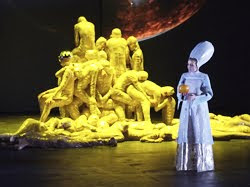
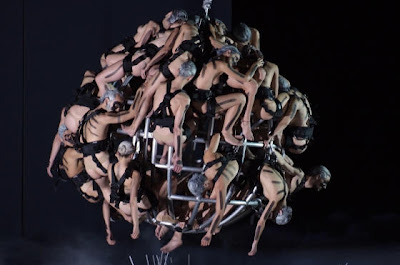
"In the words of the prestigious German weekly "Die Zeit," the stage production of Wagner's "Rheingold" and "Walküre" by La Fura dels Baus "quite possibly shows us the path that musical theater will be taking in the future." There's no doubt about it: the city of Valencia is setting new accents in 21st-century opera not only with its spectacular new theater designed by Santiago Calatrava, but also with its visually transfixing production of Wagner's "Ring" staged by Carlos Padrissa and his theater group La Fura dels Baus. The Barcelona-based Fura blends music, dance, acrobatics and technology into unforgettable stage events of sometimes raw but always captivating power."


Photos: © Tato Baeza

Siegfried Visits Beaubourg
or Verfremdungseffekt vs. Gesamtkunstwerk

Larry and I were able to see the 2008 Valencia Siegfried during a recent screening of Opera in Cinema's season last weekend (2/14) in Cleveland. I left the theater less than overwhelmed, but further reflection has led to some insights -- and greater appreciation -- for what the director (Carlus Padrissa) may have attempted. Not having seen this cycle's Rheingold or Walküre is a distinct disadvantage in trying to figure out a meaningful arc to the Valencia Ring, but any one opera in the tetralogy should be able to stand alone well enough to stand at all. So, let's blame the initial confusion on the cinematography (for now).


The cast was universally strong -- particularly Lance Ryan (Siegfried), Juha Uusitalo (Wanderer), and Stephen Milling (Fafner). Franz-Josef Kappellmann (Alberich) and Jennifer Wilson (Brünnhilde) were also effective. Gerhard Siegel's Mime, however, may provide the key to the production -- less the buffoon than is often the case and genuinely overwhelmed and frustrated by his task. But, it was Siegfried's night, and Lance Ryan was superb, looking as though he could manage another hour or so by the time he had seduced Brünnhilde.


On face value, the production, however, just did not come across as anything but a mess -- at least the way it was filmed. Much of the "action" took place on huge, multiple, and very busy projections against a rear screen which was very close to the actors. This placement compressed the very broad "stage" into a very shallow space on which to act. A highly polished black floor surface reflected the backdrop screening, increasing the motion enveloping the singers. Dancers doubled as stage hands who moved the sets around, became props (a bench for Siegfried, forest debris), and in act one even mopped the floor.


In pure Brechtian terms, the mechanics of production were all visible and became part of the performance -- from Fafner's hydraulics linking a skin of movable triangular plates; Erda's "cherry picker" seat thrust out from a crack in the filmed earth; a recreation of the Giant machines, one controlled by the Wanderer; Wotan's spear with its clearly visible break-away mechanism; projection screens opening to reveal reverse-side framework; a mobile forest of hinged, highly-polished chrome boxes. These mobiles ended in small round platforms on which Wotan and Alberich confronted each other, rising and falling, swaying side to side as light and dark vied for command of the argument. The skeleton structure is no longer invisible but takes center stage.


The design concept is similar to those employed by Renzo Piano et. al. for the Pompidou Center (Paris, 1977) where all the structural elements are not only fully exposed but also color-coded to indicate the various mechanical systems normally hidden behind interior walls. Padrissa's conception strips away all artifice, exposing the power struggles residing at the heart of the Ring story. It is also primarily a struggle for the right to tell a story that is larger than any single, unified vision of truth.


The filming, however -- with its heavy emphasis on close-up shots -- undercut much (dare I say "most"?) of the overall effect one would have had in the theater where the audience could experience the entire project as a whole. The close ups significantly reduced the perception of the singer/actors overwhelmed by the activities swirling around them, a key component of the production. On stage, the singers would have appeared as only one aspect of the theatrical presentation rather than the center where tradition -- and the filming -- placed them. On the other hand, one might safely claim that the act of cinematic montage further fragmented what Brecht might have called the constructed reality of the work itself and, consequently, enhanced the defamiliarization effect on the audience. In terms Penn and Teller would appreciate (and thanks to Larry's analogy), Padrissa and his creative team created a new illusion by stripping away all illusion.


Even the costumes support a re-reading of the characters. Siegfried is no untutored adolescent but a primitive wild man -- complete with leather and fur skins -- confused by an alien world.Mime, in white lab coat, is more a chemist (alchemist) than a mechanic overwhelmed by his need to create the impossible -- carbuncle clusters showing his laboratory experiments to have physically attacked him. The act one "dancers" -- fully protected by masks, gloves, and foot covers -- function like a haz-mat cleaning crew having to cope with modernism gone wild.Other costuming decisions directly confront expectations. If you want a real bird, then I'll give you a bird -- complete with flapping wings -- but one that is heavily strapped into her very visible flying harness. You want a traditional breast plate for Brünnhilde, then I'll give Jennifer Wilson a breast plate -- but one fit for Natalie Dessay. In a complete reversal, it is Siegfried who strips away his clothes to reveal a very virile young man. Fortunately, Brünnhilde gets rid of her confining breast plate, but only to reveal an aging woman who remains bound in a corset of bulky straps like those used at an electrocution or in a straight jacket.


I now believe -- and am more than ready to test my theory in Valencia -- that the Valencia Ringis a deliberate confrontation between modernist realism and the illusion of romantic wholeness. Brecht's theories of theater face down those of Wagner. Throughout this performance, a new, stark realism contends with previously accepted -- and still anticipated -- familiarity. The familiar "realism" of the theater is challenged and stripped away, leaving only Wagner's music as the central "reality." If, like the Wanderer and Albrecht, the conflicting theories contend for supremacy, which wins depends on the degree of alienation experienced by the viewer.


When we left the movie, I felt I learned nothing new about Siegfried from this production -- and learning something is a key element of any new experience for me. But, like the LehnhoffParisfal which initially left me angry, the Valencia Siegfried has haunted me all week. What WAS Carlus Padrissa thinking? What new was he trying to say about Siegfried, about the Ring?If we grant that Padrissa -- or Achim Freyer in LA or Francesca Zambello in SF -- is an artistwith something significant to say, then it is incumbent upon me as a viewer to work with that new idea toward understanding and, only then, judge its success or failure on its own terms rather than on a 19th century theory which can no longer claim to be the final "truth."Unfortunately, I have no idea how the initially illusive signals were developed from Rheingoldthrough Walküre to Siegfried, and I don't know how they will be resolved inGötterdämmerung. But, I am willing to bet that what left me pondering in the Cedar Lee Theater will leave me overwhelmed in the Palau de les Arts Reina Sofia.


Sandra Molyneaux -- from snowy Columbus, OH

February 17, 2010


http://www.operaincinema.com/


And here are a few photos from Rheingold and Walküre:


Wednesday, March 10, 2010

Deutsche Oper Berlin reviews - Part Zwei


Here are the rest of the Berlin reviews. Please note

that the reviewers submitted their opinions in the

form of complete essays, and I extracted paragraphs

pertaining to individual operas for compare-and-contrast

purposes. So if anything seems stilted or out of context,

that's my fault and not the reviewers'.


Photos © Bettina Stöß, 2008


Lohengrin


Jean Scarr:

I was in Berlin February 5-6-7 for the Wagner Festival at the Deutsche Oper. I saw Die Meistersinger, Lohengrin and Rienzi. The casting was strong throughout. Of particular note was the superb chorus, which serves as a vital ingredient in all three works and especially in Lohengrin and Rienzi.

The twenty-year old Götz Friedrich production was pleasure to see after dealing with Robert Wilson’s Met performances a few years ago. Recently, I was in Houston for their production, which takes place in a ruined library during the 1930's. There may have been no physical swan in Berlin, but its presence was there, especially in the first scene of Act III - a bed and floor runner covered with swan feathers and a huge circular picture of a swan in the background. I would classify the production as traditional with an aura of abstraction hovering about. It will be scrapped after this run. Conducted by Michael Schenwandt and strongly cast (Ben Heppner, Ricarda Merbeth, Waltraud Meier, Eike Wilm Schulte, Anton Keremidtchiev, and Hans-Peter König), this was a musically magical evening.


Terry Quinn:

This was one of the best Lohengrin productions I have seen in a long time, maybe ever. It was beautifully staged with no guessing games on the meanings behind the visual analogies. This 20-year old Götz Friedrich production was a straightforward piece of storytelling with no "improvements’" to what Wagner wanted to say and with beautiful sets and some nice directorial touches. There were two standouts for me. Waltraud Meier as Ortrud, a role that she now owns, and the Deutsche Oper chorus who approached Bayreuth quality with great beauty in the soft passages and spine-tingling glory in the climaxes.


Elsa was sung very well by Ricarda Merbeth, a new name to me, and Ben Heppner was an excellent Lohengrin. They deserved better recognition but were eclipsed by the amazing Meier who is not only a top drawer singer, but a brilliant actress and a master of the evil look.


Terri Stuart:

I can't agree with the others about Heppner's performance. I was in the 1st Rang dead center and Ben gave the most careful, effortful performances I've ever sat through. I was a nervous wreck at the end. The voice was often at the edge of breaking but he'd rein it in. I've seen him a number of times and even twice in recital and gone was the full sound and open voice. Eike Wilm Schulte was about the least effective Telramund I've ever watched the singing just so-so. The costume did him no favors, tight leather pants and an open to the navel black shirt. The women were a triumph - Ricarda Merbeth and the luminous Waltraud Meier. Also noted Kristin Sigmundsson (whom I adore) was indisposed and was replaced by the always wonderful Hans Peter Konig.


* * *


Photos © Bettina Stöß, 2008


Meistersinger


Terri Stuart:

I am also back from Berlin and while there met up with two other WSNC members. I have to state my own opinion because I differ in my opinions about the works we all saw - 3 were the same performances.


I saw Tannhäuser (last 2 acts), Dutchman, Lohengrin, Meistersinger and Rienzi.

First - the two Götz Friedrich productions (Meistersinger and Lohengrin) are the last death rattle of those productions. Good. While I love that Meistersinger on DVD, much of the kitsch and excess was removed for filming. In real time the Meadow Scene was so cluttered and there were enough supers on stage waving banners to create gale winds. The fire juggler nearly incinerated the wig of a super. It was pretty much the same for the Lohengrin. Moths and dust flew all over! Chorus - excellent and on par with the chorus in Bayreuth - possibly they share some of the singers.


Jean Scarr:

Götz Friedrich's Die Meistersinger was the Friday night opus. Again, we have a sane approach to this masterpiece, which is framed by the skyline of Nuremberg, but with the WWII bombed out Nuremberg in the background. (The production is on DVD). James Johnson headed the cast as Sachs. His was a credible portrayal - a youngish looking cobbler who managed to survive the rigors and demands of this role. His second act was truly remarkable, especially during the scene with Beckmesser (Markus Brück). Herr Brück was a marvel with an especially endearing voice for this role. After all, he was a mastersinger! Klaus Florian Vogt sang Walter with clarion voice, seemingly tireless as he progressed through all those "Prize Song" refrains. The Eva of Michaela Kaune; the Magdalena of Ulrike Hetzel; and the David of Paul Kaufmann were all stellar. Donald Runnicles conducted, but unfortunately some of the audience greeted him with boos. Why, I don't know.


* * *


Photos © Matthias Horn, 2008


Dutchman

Terry Quinn:

There was no ship, the action took place in what looked like a stock exchange. There were two Sentas, only one of whom sang and not all that well, especially at the beginning. Instead of sewing machines the women combed and recombed their hair. Senta cuts Eric’s throat and then her own. The knife was then passed down the line and as the curtain fell the chorus were taking it in turns to use the knife on themselves. This triggered sustained booing from all parts of the house. I for one did not disagree. Enough said.


As we commented on leaving our third Wagner opera of the week, two out of three ain’t bad.


Terri Stuart:

The Flying Dutchman was extremely well sung but the production was just a disaster, in my view. It opened in a commodities trading floor, segued to a theatre back-stage make-up room (I guess the spinning meant rolling up hair on curling irons?) and the finale was a mass-suicide zombie cocktail party with Senta stabbing Erik with scissors, slashing her throat, and handing the scissors to the rest of the women who sequentially slashed their throats as the Dutchman walked away. All of this to the revised redemptive ending - harps plucking away. For whatever reason they stinted on the off-stage chorus for the ghost sailors and they were barely audible. UGH


* * *


Photos © Matthias Horn, 2008


Tannhäuser


Terri Stuart:

My train was delayed and so I missed the 1st Act of Tannhäuser so I can't speak to the dramatic arc, but what I saw was pretty good. I couldn't work out the Elizabeth/Venus reincarnation - but not having seen Act 1, I won't discount what the director did. Stephen Gould continues to amaze for his stamina combined with technique that results in glorious singing. It is so wonderful to hear a lieder singer in the role of Wolfram and Dietrich Henschel delivered the goods. Petra Maria Schnitzer was the Elizabeth/Venus - I'm not a fan but apparently she is highly regarded in Berlin. I loved the cold hard, shining but hollow suits of armor which created the basis of this production.


Terry Quinn:

We are now 3 and 1 and, for a while anyway, Eurotrash is taking a back seat. This was an excellent production with no weird gimmicks but imaginative use of the Deutsche Oper’s stage technology. The first two acts were performed on an essentially empty stage with plain drapes at the sides and back. The visual magic was in the extensive use of flying techniques and the multi-level stage lifts. The stage frequently dropped out of sight of those of us in the orchestra seats to reappear populated with Bacchanalian dancers, noblemen and women, Landgraf Herrmann and his knights on horses wheeled around by attendants, and, of course, pilgrims. The flying figures were mostly the Langraf’s knights and the departing demons when Tannhäuser decides to abandon Venus. When the final scene rises into view the stage is filled with hospital beds occupied by pilgrims, presumably recovering from their journey from Rome.


American tenor Stephen Gould sang the title role, Nadja Michael had a powerful voice for one so slim. (I wonder if she will ever manage Brünnhilde?) Reinhard Hagen was convincing as the Landgraf and Dietrich Henschel was Wolfram von Eschenbach. His more lyric tenor voice contrasted well with the other lead singers. Was it his voice or the well acted, tender sympathy shown to the dying Elizabeth that made me more sympathetic to Wolfram than to Tannhäuser?


Once again, the chorus was a standout for me. In place of the more usual off-stage introduction of the Pilgrim’s Chorus, the singers sang or so softly while lying on their beds. But when they sat up for the final chorus, the stepped stage resulted in an amazing wall of sound hitting the audience.


Director Kirsten Harms created a Tannhäuser without irrelevant creativity yet was satisfying to the ear, eye and intellect. I hope that he will take aside his colleague who directed the weird Dutchman and tell her, ‘Now look here, Tatjana…’


Thanks to all the reviewers. It's always fun to see how much folks can disagree on a production!

Stay tuned for Sandra's review of the high-def broadcast of the 2008 Valencia Siegfried.